
Because whippets (nitrous oxide/N₂O) are increasingly appearing in corner stores, gas stations etc. and are ever-evolving, CANDLE, Inc. maintains this article as a resource for parents, prevention professionals and communities encountering the problem. We will continue to add important research, news and legislative developments while preserving the timeline of how one community confronted the problem and what others can learn from that experience.
In gas stations, smoke shops, and on Amazon.com, a dangerous drug is hiding in plain sight. It comes packaged in candy colors, sold in flavors like "vanilla cupcake" and "mango smoothie," and has gone viral on TikTok. It is called whippets — steel canisters or tanks of nitrous oxide (N₂O) — and the national crisis they are fueling is no longer a quiet local problem.
A landmark study published in JAMA Network Open found that U.S. deaths from nitrous oxide misuse jumped 578% between 2010 and 2023. In that same period, 156 individuals died in a single year from inhaling the gas. In Southwest Detroit, ER visits tied to whippet use surged 757%.
At least five states have now enacted bans, manufacturers face hundreds of millions of dollars in lawsuits, and Amazon is named as a defendant in a growing federal case. As of August 2026, this case is in its early stages, with additional plaintiffs joining.
This is no longer a fringe issue. This is a national public health emergency — and this article is the most complete, current, and community-action-ready resource available.
What Are Whippets? Nitrous Oxide Explained
Whippets (also spelled whippits or whip-its) are steel cartridges or canisters filled with nitrous oxide (N₂O), commonly known as laughing gas. They are manufactured to recharge commercial whipped cream dispensers used in restaurants, not household appliances most people own. The gas inside is the same one dentists use safely in controlled, oxygen-supplemented settings.
Traditional whippets for commercial use are small nitrous oxide cartridges. Today, they are sold in much larger canisters and tanks, often in brightly colored packaging and flavors.
On the street and online, whippets go by many names: NOS, nangs, hippy crack, buzz bombs, balloons, Galaxy Gas, Whip-It!, Baking Bad, Cosmic Gas, HOTWHIP, Miami Magic. The product comes in several forms:
- Small cartridges — about 3 inches long, sold in packs of 25 or 50
- Large canisters — resembling a small fire extinguisher, offering 100 or more hits
- Industrial tanks — the size of camp stove propane tanks, seized in multi-million dollar busts in cities like Los Angeles
To use whippets recreationally, users pierce a cartridge with a small tool called a "cracker," release the gas into a balloon, and inhale it. Some inhale directly from canisters — a practice that can cause severe frostbite, as the gas reaches temperatures of negative 40°F upon release.
Important distinction: Whippets are NOT the same as canned whipped cream sold in grocery stores. They are industrial nitrous oxide cartridges being misused as an inhalant drug.
FDA Warning: Nitrous Oxide Products and Brand Names to Know
The U.S. Food and Drug Administration (FDA) warns consumers not to inhale nitrous oxide from any size canister, tank or charger. Recreational inhalation can cause serious health effects including loss of consciousness, vitamin B12 deficiency, blood clots, paralysis, psychiatric problems, spinal cord or brain damage — and, in some cases, death. The FDA says these products are being sold online as well as in smoke/vape shops and gas stations. (U.S. Food and Drug Administration)
The products may look very different from the small silver “whippet” cartridges many people recognize. Large, colorful and sometimes flavored nitrous oxide canisters are sold under numerous brand names. In its most recent update, the FDA identified brands including:
- Galaxy Gas
- Whip-it!
- Baking Bad
- Cosmic Gas
- ExoticWhip
- FastGas
- HOTWHIP
- Monster Gas
- MassGass
- Miami Magic
- Cloud 9ine
- Euro Gas
- NITROX
- Goo Sticks
- InfusionMax
In its June 4, 2025 update, the FDA said it was continuing to track reports of adverse events from nitrous oxide inhalation and misuse. The agency specifically added ExoticWhip, FastGas and NITROX to its list of product brand names of concern. (U.S. Food and Drug Administration)
The Health Risks: Serious, Fast, and Sometimes Permanent
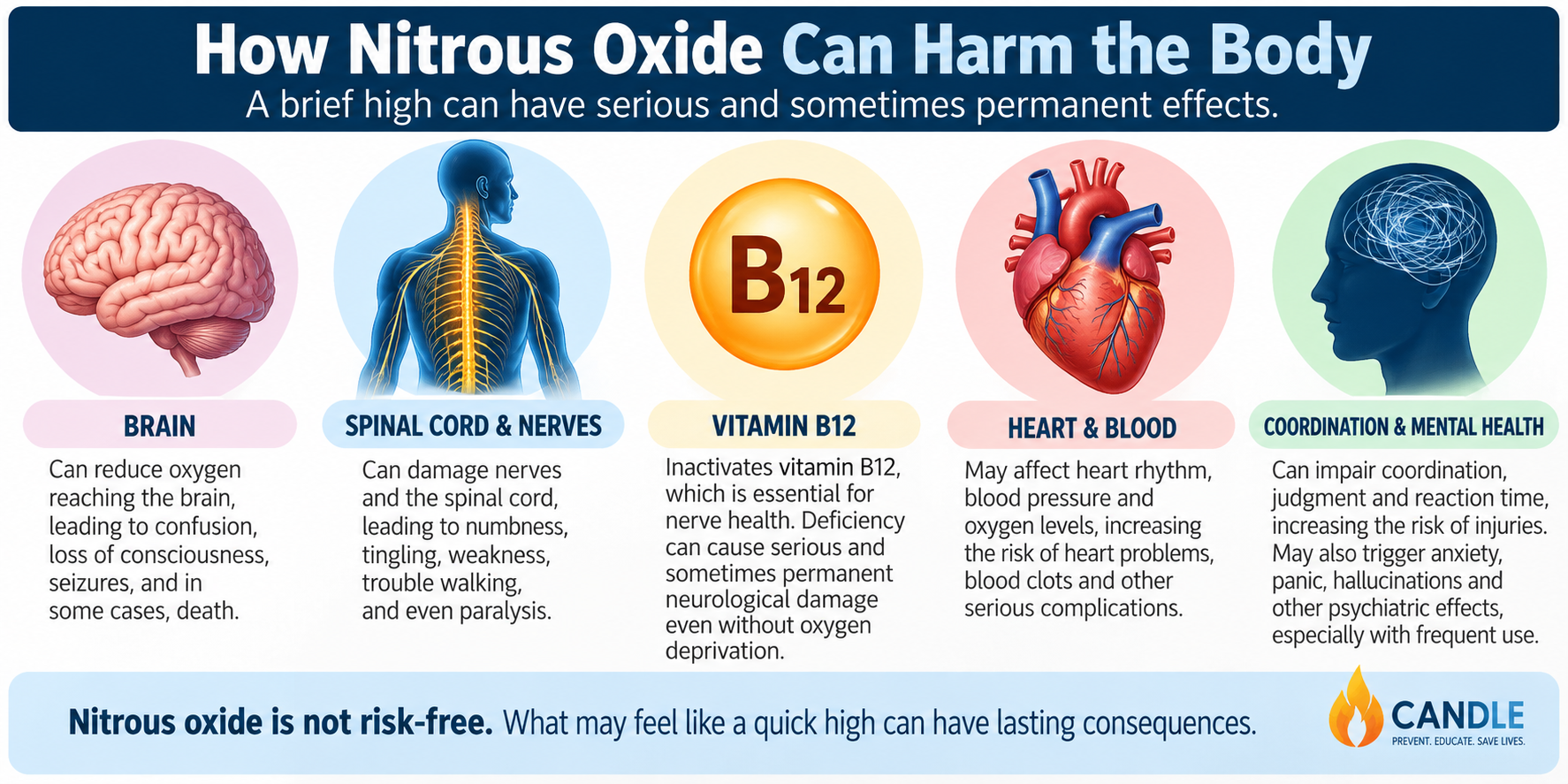
The dangers of whippets are real, medically documented, and in many cases irreversible. Here is what the science says.
How Whippets Harm the Body
Nitrous oxide displaces oxygen in the brain. Each hit starves the brain of oxygen for the duration of the high, typically 30 seconds to two minutes. Because the high fades so quickly, users inhale repeatedly, compounding the oxygen deprivation with every use. According to Cleveland Clinic, the more a person inhales, the more they decrease oxygen in the body and increase risk of harm.
But oxygen deprivation is only part of the problem. A 2025 scientific review found that nitrous oxide disrupts the body's ability to use vitamin B-12 and produce myelin, the protective sheath around nerves and brain cells. According to Riley Children's Health at Indiana University, continued abuse lowers B-12 levels, causing myelopathy — a form of spinal cord injury that leads to difficulty walking, tingling, numbness in the extremities, and in severe cases, paralysis.
Published case reports in peer-reviewed medical journals document patients who inhaled 80 to 100 canisters per day for just three months before developing spinal cord lesions visible on MRI — with neurological deficits that persisted even after B-12 supplementation.
Short-Term Effects
- Euphoria and dizziness lasting seconds to two minutes
- Slurred speech and loss of coordination
- Headache, nausea, and palpitations
- Frostbite of the mouth, throat, and lips from direct canister inhalation
- Sudden loss of consciousness, a leading cause of fatal accidents
- Dangerous drop in blood pressure
Long-Term and Permanent Effects
- Vitamin B-12 deficiency leading to spinal cord damage (myelopathy)
- Peripheral neuropathy — numbness, weakness, and loss of sensation in limbs
- Paralysis, documented in users as young as their 20s
- Blood clots (one documented user developed 36 clots in her neck, lungs, and head)
- Psychiatric symptoms including hallucinations, paranoia, and delusions
- Brain damage, particularly to the prefrontal cortex, which controls decision-making and memory
- Organ damage to the heart, liver, and kidneys
- Seizures, coma, and death
According to Nationwide Children's Hospital, long-term brain damage is especially concerning in young people because nitrous oxide affects the prefrontal cortex — the part of the brain still developing in adolescents that governs learning, memory, and judgment.
Nitrous oxide also increases dopamine in the brain's reward pathway, which can reinforce addiction. Heavy users report strong cravings and withdrawal symptoms including irritability and anxiety when they stop.
"It might seem harmless at first, but it could just take one use."
— David Berg-Lewis, Emergency Medicine Clinical Pharmacist, LifeBridge Health, Maryland
Dr. Madeline Renny, a pediatric emergency medicine physician at Mount Sinai Health System in New York City, has warned that even a single use can prove fatal, with symptoms ranging from headache and palpitations to passing out and death.
Critical note for parents and doctors: Nitrous oxide is not detectable on a standard drug screen. A person presenting with neurological symptoms may never be diagnosed correctly unless the provider specifically asks about whippet use. If B-12 levels appear normal, doctors should also check methylmalonic acid (MMA) and homocysteine levels, which will be elevated and provide a more accurate picture of B-12 depletion.
Galaxy Gas, TikTok, and How Social Media Fueled the Whippet Trend
Whippets have existed for decades, but a new generation of flavored, brightly colored products led by Galaxy Gas turned a niche inhalant into a viral phenomenon.
Galaxy Gas canisters, manufactured by Georgia-based SBK International LLC, were designed with candy-like flavors and eye-catching packaging. Videos of young people inhaling the gas spread across TikTok, YouTube, and Instagram, earning hundreds of thousands of views. According to CBS News, the trend gained traction through game streamers, influencers, and musicians who featured nitrous oxide in their content.
The backlash was significant. TikTok banned "Galaxy Gas" from its search results. YouTube age-restricted related videos. Galaxy Gas LLC halted sales in September 2024 out of an abundance of caution. But the damage had been done, and products under dozens of other brand names continue to be sold freely online and in stores.
Galaxy Gas may have become the best-known name, but it is only one brand in a much larger market. The FDA has since identified numerous nitrous oxide products of concern, reinforcing that the problem extends far beyond a single company or social media trend.
Musicians SZA and Lil' Gnar have spoken out publicly against the trend. SZA specifically warned that the product "is being MASS marketed to black children." The Washington State Attorney General's Office drew explicit comparisons to tobacco industry marketing tactics — colorful, targeted, and engineered to normalize addiction among the young.
One Person's Story: "I Couldn't Walk Across a Room"
The following account was submitted by a reader after reading our original blog post. It is shared with his permission.
"When I was in high school, I used whippets from time to time with friends. I never saw any real long-lasting consequences, so I never investigated the risks. I knew they were a dumb thing to do. I never thought of whippet drugs in the same sentence as real danger.
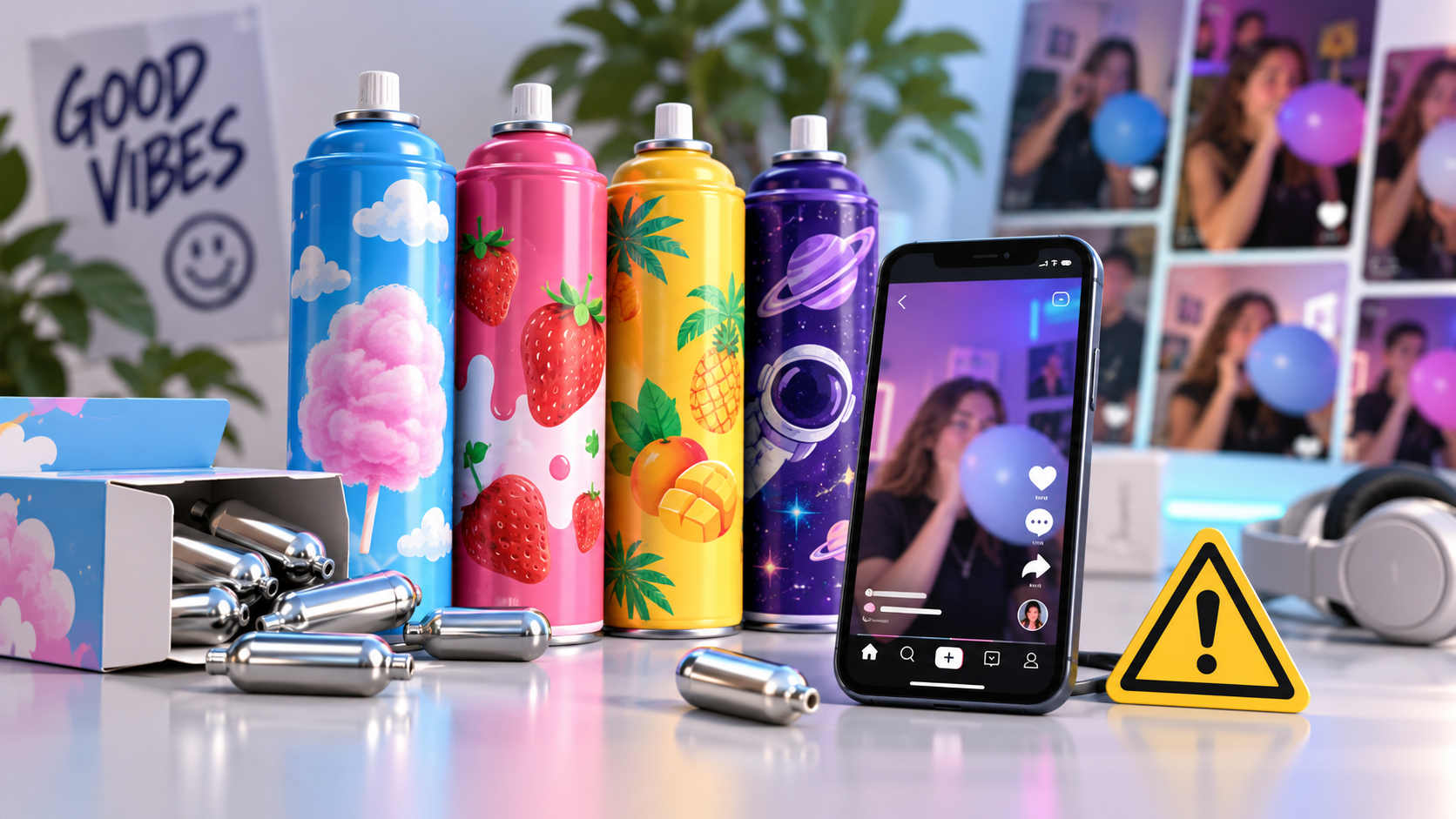
In 2022, I was a healthy 28-year-old. During Mardi Gras, I picked up a carton on a whim, just like high school. It became a weekend habit. My clerk at the smoke shop showed me the new tank size, like a small fire extinguisher. I bought it at least twenty times before trouble set in.
All of a sudden, I was having trouble walking. My legs just would not move right. I could not think or see straight. I was terrified I had a brain tumor. The ER ran every test. No one connected it to nitrous oxide.
Eventually my own searching led me to an article about whippets depleting vitamin B-12. Every symptom I had was listed there. The neurological damage was real.
Now, a year later, I have a job I love — but my awkward gait has not gone away. I cannot run or jump, and I do not know if I ever will. What I do know is that I genuinely want kids to understand how easily everything can go wrong. Not until you are telling a doctor that your legs do not work right, your vision is blurred, and you get confused easily will you fully understand what you just read here."
This story is not unique. Kelly Rosenthal shared her nitrous oxide addiction story publicly in May 2025, describing 36 blood clots in her neck, lungs, and head that required brain surgery. She died months later. A woman in Louisiana documented partial paralysis after spending over $220 a day on nitrous oxide canisters she obtained from a local convenience store.
Why Young People Are Especially Vulnerable to Whippets
Young people remain especially vulnerable to inhalant misuse. In SAMHSA’s 2025 National Survey on Drug Use and Health, 1.4% of adolescents ages 12–17 and 1.8% of young adults ages 18–25 reported past-year inhalant use, compared with 0.6% of adults age 26 and older. Nitrous oxide, or whippets, is included among the inhalants measured in the survey.
A perfect storm of factors makes youth especially at risk:
- The high lasts only minutes. Parents will not notice. Teens consider this a feature, not a warning sign.
- It does not show on a drug screen. Nitrous oxide is undetectable by standard testing, giving users confidence they will not get caught.
- It looks legal and safe. Sitting on a gas station shelf in bright packaging sends a powerful message to a 14-year-old: this must be okay.
- Body weight increases risk. The Alcohol and Drug Foundation found that lower body weight in adolescents increases the effective dosage of nitrous oxide, a warning that never reaches young users.
- Social media normalizes it. Videos of influencers inhaling Galaxy Gas accumulated millions of views, with hashtags and challenges making it appear to be a harmless dare.
- Tolerance builds quickly. According to Riley Children's Health, users need more of the gas over time to achieve the same effect, accelerating both use and damage.
Why Whippets Can Be Especially Risky for Teens
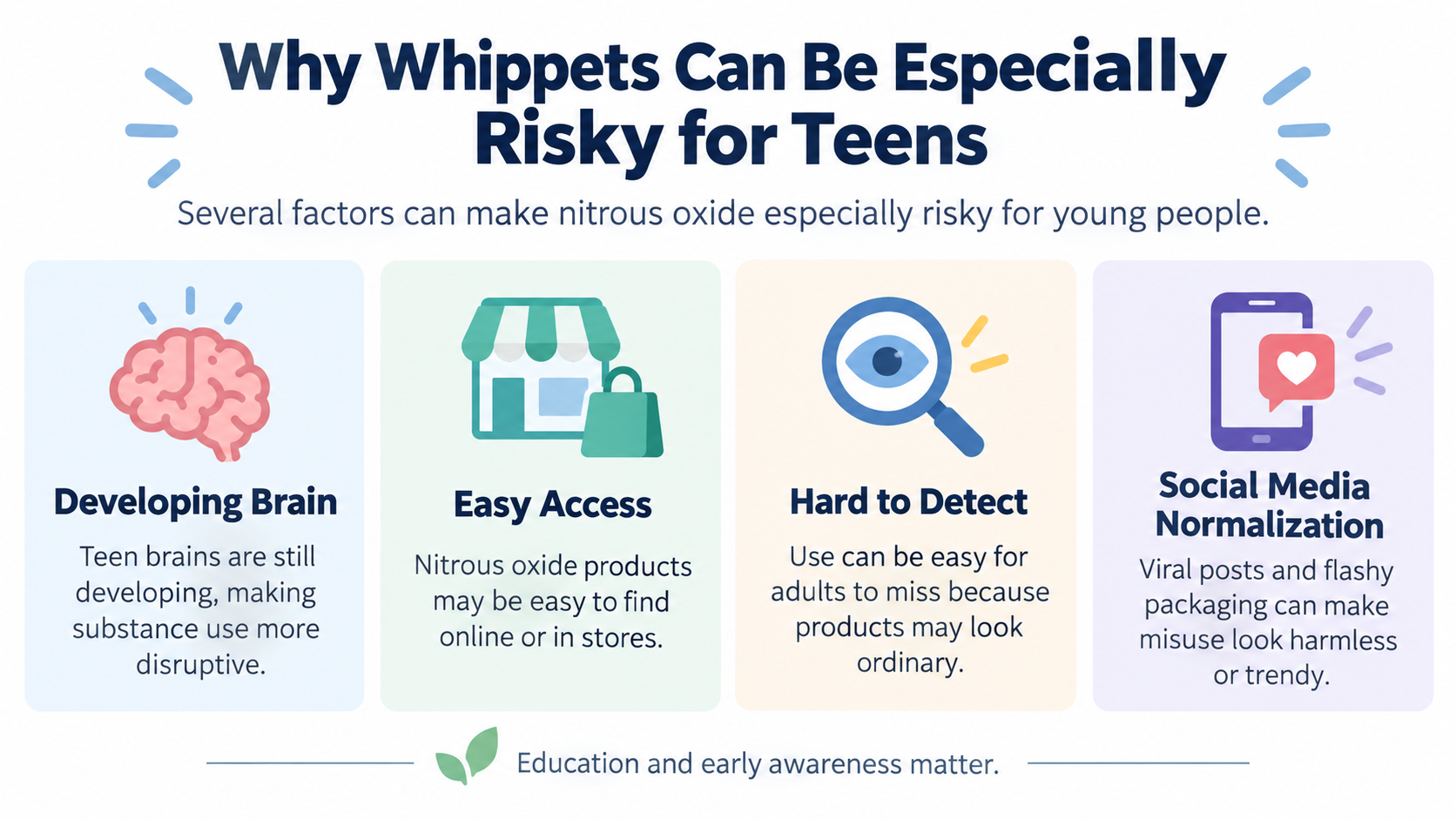
The larger pattern is clear: inhalant use remains disproportionately concentrated among adolescents and young adults compared with older adults, making early education and prevention especially important.
The Legal Reckoning: Lawsuits, State Action, and a Federal Push for Change
The whippet industry is now facing a wave of litigation and legislation that may reshape how nitrous oxide products are sold, marketed, and labeled across the United States. Lawsuits increasingly question whether manufacturers, retailers, and online marketplaces knew that products sold for culinary purposes were being purchased for recreational inhalation. At the same time, earlier legislative efforts provide a roadmap for communities seeking stronger protections today.
Key Cases and Verdicts
$745 Million Jury Verdict (2023): A Missouri jury awarded the family of Marissa Politte $745 million after she was struck and killed by a driver who lost consciousness after inhaling Whip-It! nitrous oxide. The jury assigned 70% of the responsibility to distributor United Brands Products. Testimony at trial indicated that a large share of the company’s product was being distributed to smoke shops rather than traditional culinary users.
Amazon Litigation: Litigation involving nitrous oxide products sold through Amazon expanded in 2026, with federal cases alleging injuries connected to canisters, cartridges and tanks sold through the marketplace. The cases raise questions about product warnings, third-party sellers, and what online marketplaces know about recreational use.
Galaxy Gas Litigation: A federal class-action complaint filed in Georgia alleges that Galaxy Gas and related companies designed, marketed and sold nitrous oxide products in ways that encouraged misuse and failed to provide adequate warnings. The litigation is part of a broader examination of flavored products, colorful packaging and sales through smoke shops and other non-culinary outlets.
Legislative Efforts: What Has Been Tried — and What Is Happening Now
Myles Edward Scott Act: Federal concern is not new. The Myles Edward Scott Act was first introduced in Congress in 2018 and was reintroduced in 2021 as H.R. 3470. Named for Myles “Eddie” Scott, who was killed in a crash involving nitrous oxide impairment, the legislation called for the federal government to study how states regulate nitrous oxide and recommend federal requirements to protect public health and safety. Although it did not become law, it remains an important example of an early effort to move the problem from local concern to federal action. (GovInfo)
Meg’s Law — Florida: In 2026, Florida enacted “Meg’s Law,” named for Margaret “Meg” Caldwell. The law prohibits licensed tobacco and nicotine dealers from possessing, selling, delivering or giving nitrous oxide on or from their licensed premises. Grocery stores and supermarkets are exempt, preserving legitimate food uses. The law was signed in June 2026 and takes effect October 1, 2026. It provides a current example of how a state can target the retail outlets most associated with recreational sales without banning legitimate culinary use. (Florida Senate)
Nitrous Oxide Safety Act of 2026 — H.R. 7945: The current federal proposal goes considerably further. Introduced in March 2026, the Nitrous Oxide Safety Act would prohibit the sale of nitrous oxide consumer products while providing exceptions for legitimate uses. On September 1, 2026, a House Energy and Commerce subcommittee forwarded the bill to the full committee without amendment — an important step in federal consideration of the issue. (GovInfo)
Together, these efforts show an evolution in the response to nitrous oxide misuse — from studying state approaches, to restricting sales at high-risk retail outlets, to considering a broader federal standard. They also demonstrate that communities do not have to wait for a single national solution to begin pursuing meaningful protections.
Lawsuits are ongoing across Florida, Georgia, California, Louisiana, and Washington State. If you or a loved one has suffered injury, consult a qualified attorney about your options.
Search Current Nitrous Oxide Legislation in Your State
States are taking different approaches, including age restrictions, limits on flavored products or large canisters, restrictions on sales in smoke and vape shops, and protections that preserve legitimate culinary, medical, dental and industrial uses.
These approaches can provide useful examples for communities exploring what may work in their own state.
Use this link to search for nitrous oxide by state.
(opens in new tab)(opens in new tab)
Southwest Detroit: How One Community Fought Back Against Whippets
Before the lawsuits. Before the state bans. Before the JAMA study. Southwest Detroit was already fighting back.
In 2020, residents began noticing thousands of small metal cartridges littering their streets and parking lots. Most did not know what they were looking at. When they learned, the community responded with urgency and organization, and created a model that communities across the country can replicate.
Frank Venegas Jr., CEO of the Ideal Group, helped launch the Whippet Wipeout Coalition:
"We have a growing concern about the volume of whippets being used by residents who are breathing in nitrous oxide to get high. This behavior is incredibly dangerous and can be fatal. This creates a public safety issue when thousands of empty cartridges are littering our streets and parking lots. These small whippets get into tires and cause flats and blow-outs — and are a danger to pedestrians, cyclists, and scooter riders."
In less than one month, coalition volunteers cleaned up over 25,000 whippet cartridges from Southwest Detroit streets and parking lots. They developed safety protocols for handling potentially pressurized discards, created community education materials, and engaged city officials and state legislators — ultimately helping build momentum for Michigan's landmark 2024 legislation.
From Cleanup to Community Action
- 2020 — A coalition forms. Businesses, nonprofits, residents, law enforcement, health professionals, elected officials and prevention organizations came together through the Southwest Detroit Whippet WipeOut Coalition.
- 2021 — Prevention becomes a priority. CANDLE, Inc. led the coalition’s Education Committee, bringing its experience in prevention implementation and community networking to the effort and developing information and resources that could be shared beyond Detroit.
- 2024 — Community concern reaches the state level. Michigan enacted Public Acts 18 and 19, prohibiting the knowing sale of objects specifically designed for recreational nitrous oxide inhalation and establishing penalties for violations. (Michigan Legislature)
- The problem continues to evolve. Sylvia Gucken of the Ideal Group has helped document the changing face of nitrous oxide misuse, including the shift from the small cartridges that once covered neighborhood streets to much larger containers.
A Community Model Others Can Use
The strength of the Southwest Detroit response came from combining trusted community leadership with prevention expertise. Ideal Group founder Frank Venegas Jr. and longtime community leader Sylvia Gucken have remained deeply involved in Southwest Detroit and in 2026 were jointly honored by the Southwest Detroit Business Association with its Community Investment Award. (EL CENTRAL Hispanic News)
With the nonprofit CANDLE, Inc. contributing its experience in innovative prevention implementation and community networking, the effort moved beyond simply cleaning up discarded cartridges. The larger goal became education, coalition-building, policy change and the creation of practical strategies that other communities could adapt when confronting nitrous oxide misuse.
Southwest Detroit’s experience offers a roadmap: recognize the warning signs, document the problem, bring the right community partners together, educate the public and pursue change.
Tragedy in Suburban Detroit: N₂O/Gas Explosion
On March 4, 2024, a young man was killed when a warehouse in Clinton Township, Michigan, was leveled in a catastrophic explosion. The building, operated by Select Distributors and associated with the brand “Goo,” was storing large quantities of nitrous oxide tanks illegally. Clinton Township officials confirmed that improperly stored canisters containing nitrous oxide and butane were involved and that the business was not permitted to store those materials.
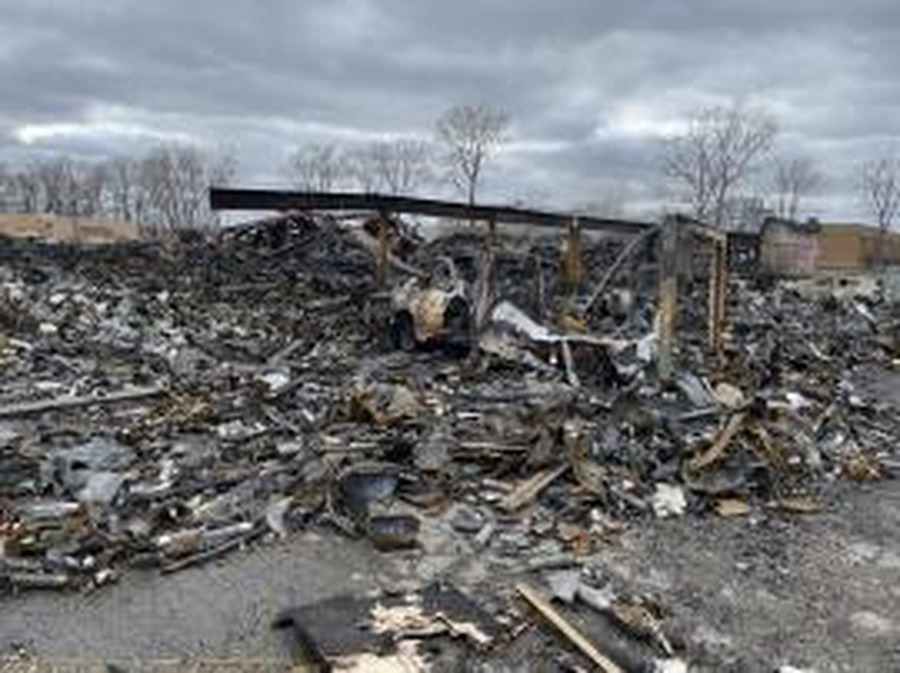
The explosions sent canisters and debris into the surrounding community. One firefighter was injured. Residents described the sound as deafening. The young man who lost his life was struck by debris about a quarter-mile from the building. Clinton Township declared a local state of emergency as surrounding homes shook.
Firefighters faced a nightmare scenario: continuous chain-reaction explosions prevented them from accessing the building. The tragedy is a stark reminder that the N₂O supply chain — trucks, warehouses, and shops — carries explosive risk that extends far beyond the individual user.
The Environmental Impact
Nitrous oxide is also a powerful greenhouse gas with about 273 times the global warming potential of carbon dioxide over 100 years and also contributes to depletion of stratospheric ozone.and remains in the atmosphere for more than a century. Nitrous oxide also contributes to depletion of the Earth’s protective ozone layer.
The mass disposal of pressurized metal cartridges and larger canisters — tens of thousands at a time in communities like Southwest Detroit — creates an additional litter, recycling and safety problem. Discarded containers may still contain residual pressurized gas and should not be handled casually.
The Whippet WipeOut Campaign developed safety training for collecting discarded cartridges. Communities facing the same problem should seek appropriate local disposal guidance before organizing volunteer cleanup efforts.

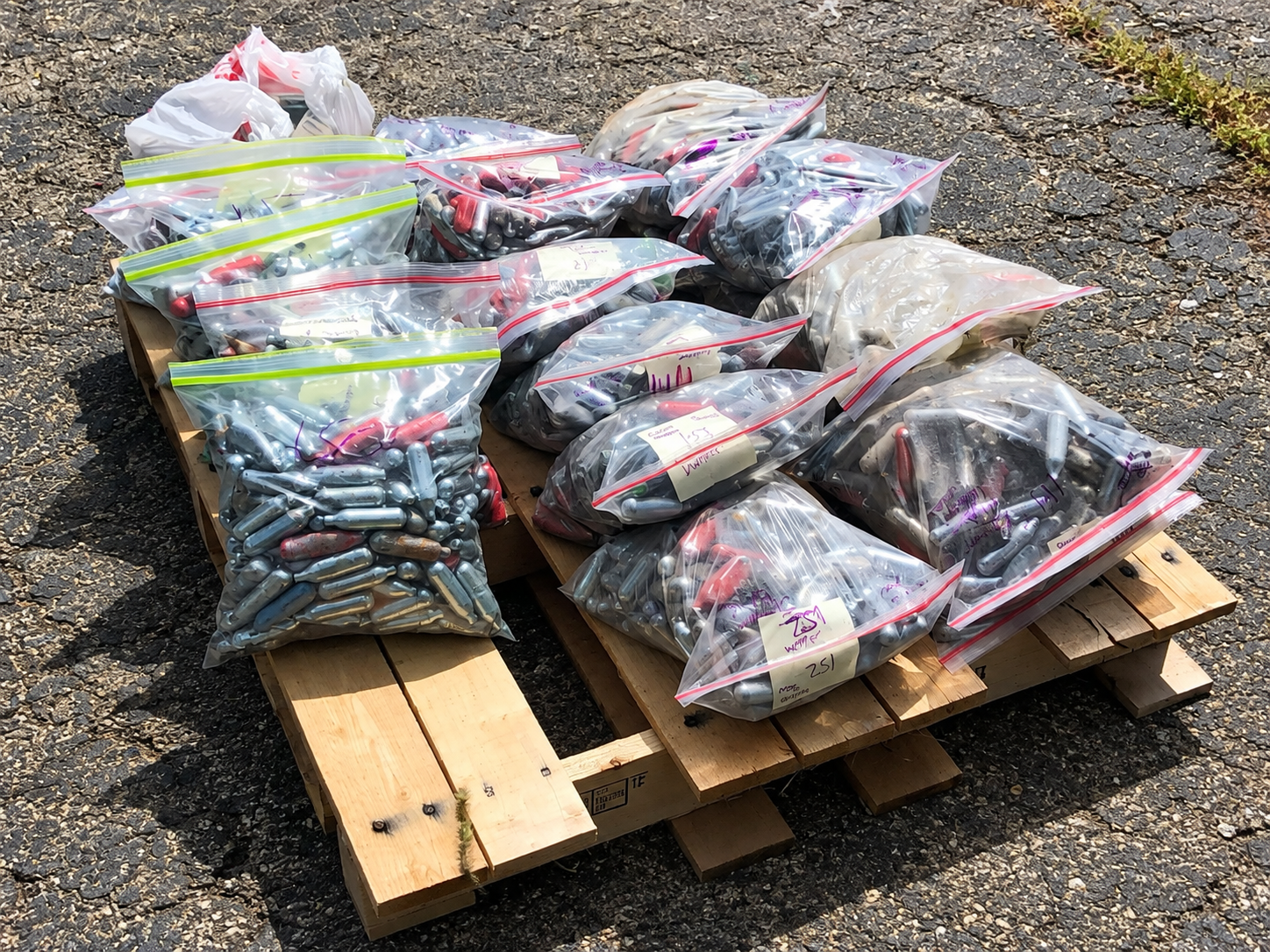
Discarded whippet cartridges became an environmental and public-safety problem in Southwest Detroit as thousands began appearing on streets, sidewalks and parking lots. Local organizer Frank Venegas Jr. reported that the small metal cartridges were getting into tires, contributing to flats and blowouts, and creating hazards for pedestrians, cyclists and people riding scooters. Volunteers with the Whippet Wipeout Campaign began collecting the discards by the thousands.
A used whippet cartridge should not automatically be assumed to be completely empty. Nitrous oxide is stored under pressure, and residual gas may remain after use. N₂O is not flammable itself, but it is an oxidizing gas that can intensify fire, and pressurized containers may rupture if heated. For that reason, discarded cartridges should not be deliberately punctured, crushed, burned or tossed into a fire simply to prepare them for disposal.
The remaining gas is also an environmental concern. Nitrous oxide is a powerful greenhouse gas; EPA currently lists its 100-year global warming potential at about 273 times that of carbon dioxide, and it remains in the atmosphere for more than a century. Nitrous oxide also participates in chemical reactions that damage stratospheric ozone.
Finding a safe way to dispose of thousands of collected cartridges proved surprisingly difficult. When the Whippet Wipeout effort contacted EPA for guidance, a clear disposal destination was not identified, illustrating a gap communities faced as this new form of drug-related litter emerged. Today, EPA advises communities to check with local solid-waste or household-hazardous-waste programs about compressed-gas containers rather than assuming they belong in ordinary trash or curbside recycling.
There is now an instructive example of how these materials can be handled professionally. After the catastrophic 2024 Goo warehouse fire in Clinton Township, Michigan, EPA oversaw the collection and treatment of thousands of nitrous oxide cylinders. More than 28,000 cylinders were degassed, devalved and recycled, demonstrating that the metal itself can ultimately be recovered once the compressed-gas hazard has been properly addressed.
The Southwest Detroit Business Association (SDBA), a key partner in the Whippet Wipeout Campaign, helped support the coalition’s work to address whippet abuse, litter and safe cleanup.
The campaign developed safety practices for collecting discarded whippet cartridges and supports community-wide collection and responsible disposal.
SDBA continues to provide information about the Whippet Wipeout effort and its resources for other communities facing similar problems. To contact, email: info@southwestdetroit.com
When an Inhalant Doesn’t Look Like a Drug
Whippets belong to a much larger category of inhalant abuse — and that helps explain why experimentation can begin so casually.
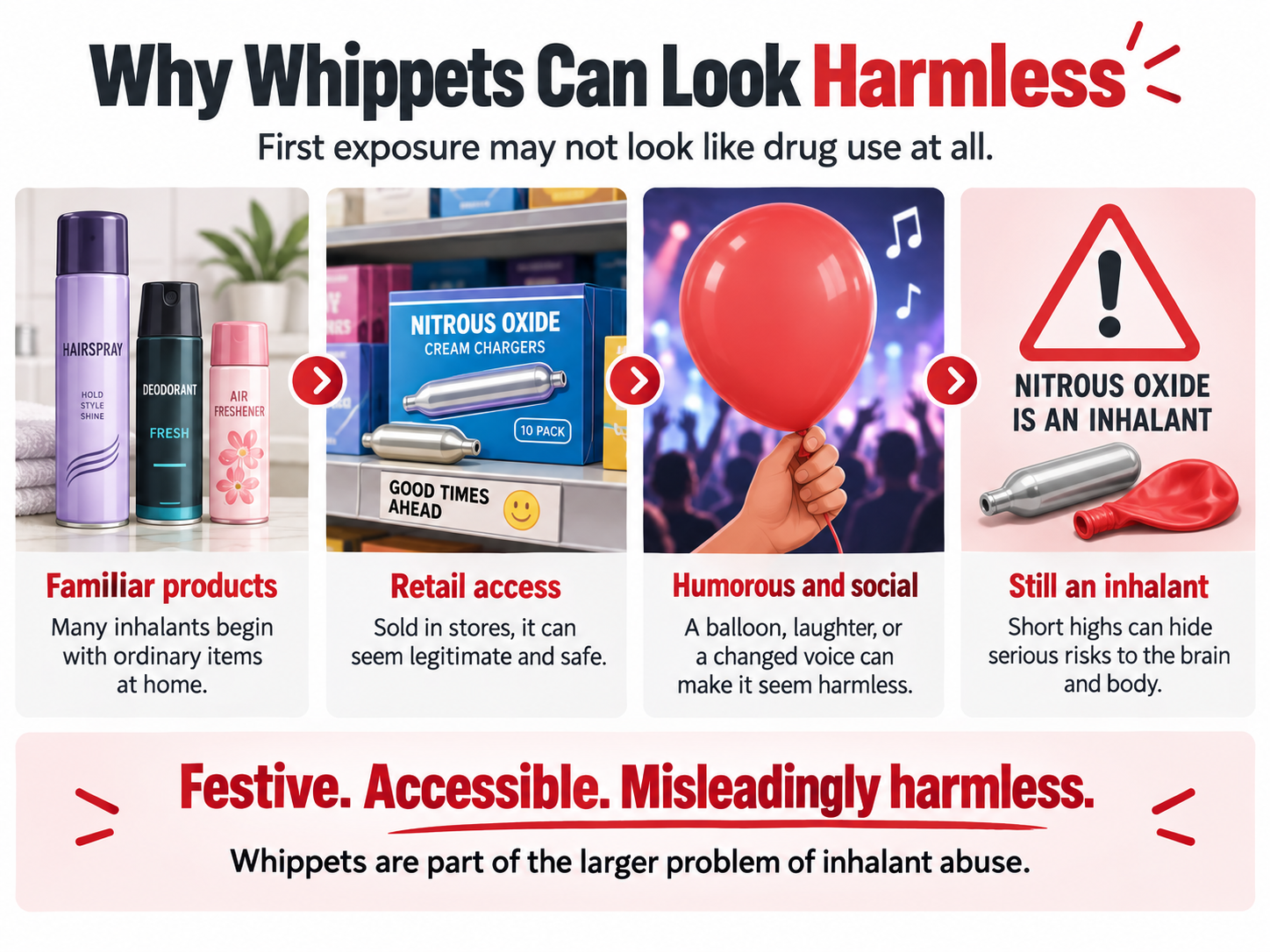
Unlike an illegal drug handed over in a baggie, inhalants may start with familiar products already found at home or in a store: aerosol sprays, hairspray, computer duster, gasoline, glue and solvents. SAMHSA notes that inhalants are often among the first substances adolescents misuse because they are inexpensive, readily available and easy to conceal.
Nitrous oxide may look even less threatening. Put it in a brightly colored balloon at a concert or party and the setting looks festive. Research involving young people who use nitrous oxide finds that it commonly appears in social settings such as house parties and music festivals, often alongside alcohol. The brief high can bring laughter, distorted sounds and a temporary change in the voice. That odd, squeaky voice has itself become part of viral social-media videos — making the behavior look funny before it looks dangerous.
Then there is the retail shelf. Michigan health officials warned in 2026 that nitrous oxide products are widely available in grocery stores, smoke shops, vape stores, gas stations, convenience stores and online. The FDA has likewise identified sales through major online retailers and smoke/vape shops and gas stations. To a young person, ordinary retail availability can unintentionally send a powerful message: If I can buy it here, how dangerous can it really be?
That is what makes inhalants different from many other drug threats: the first exposure may not look like drug use at all.
Warning Signs of Whippet Use: What Parents and Educators Should Know
Physical Signs
- Slightly drunk appearance without alcohol odor
- Red or glassy eyes
- Runny nose
- Chemical smell on breath
- Sores, redness, or frostbite marks around lips and mouth
- Blue or pale lips or fingertips — a sign of oxygen deprivation, call 911 immediately
- Loss of appetite
Behavioral Signs
- Sudden, brief episodes of uncontrollable laughter or dizziness
- Slurred speech or difficulty walking
- Weakness, balance problems, or numbness in hands or feet
- Memory problems, confusion, or mood changes
- Paranoia or unusual beliefs
Physical Evidence
Many residents may not recognize whippet-related litter at first. In Southwest Detroit, unusual metal cartridges and other related items began appearing in streets, parking lots, and public areas before many residents understood what they were seeing.
The image below shows some of the most common whippet-related items and discards, including the kinds of evidence a neighborhood may suddenly begin noticing.
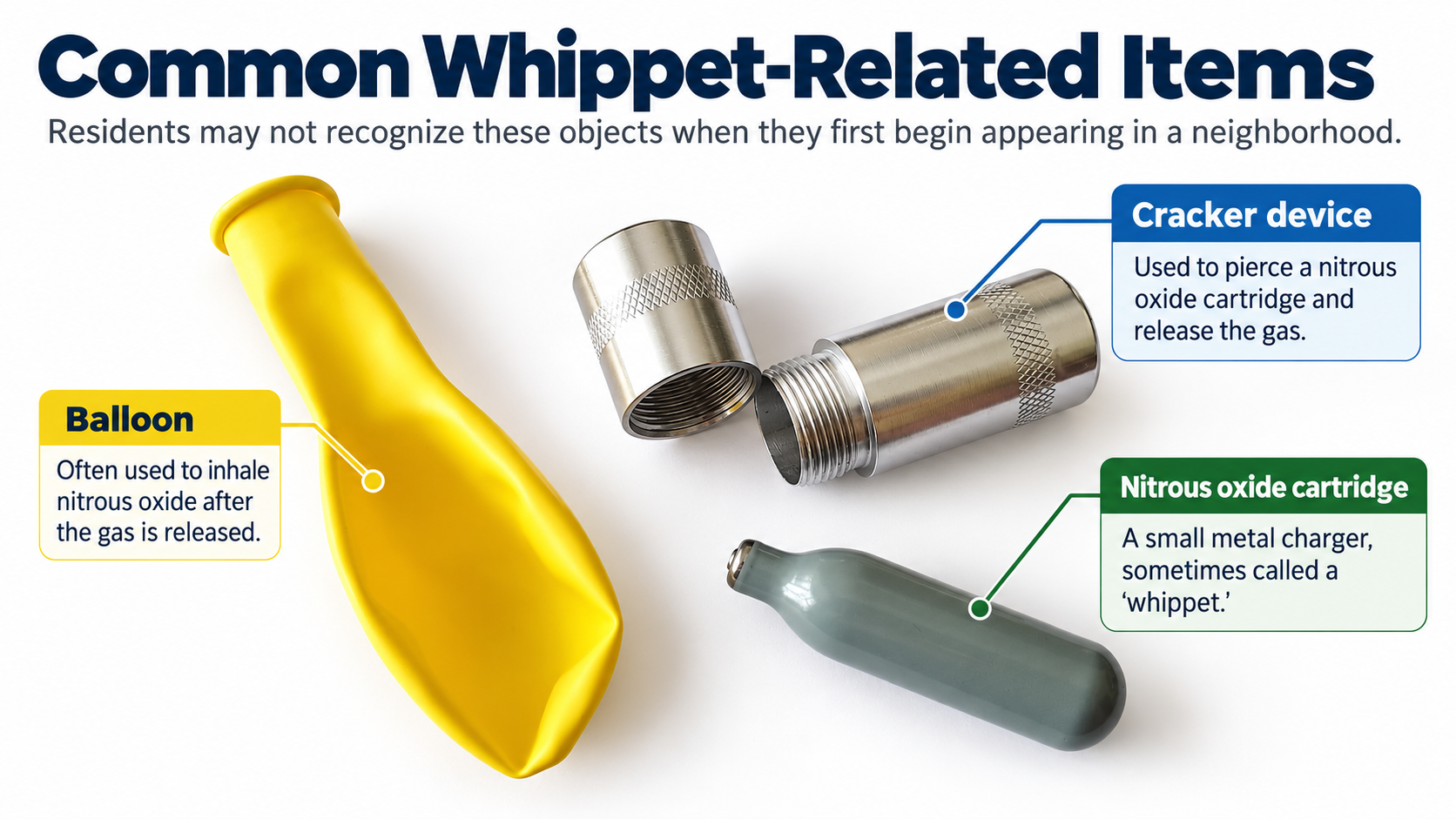
- Small metal cartridges about 3 inches long — the most definitive sign
- Larger canisters resembling a fire extinguisher
- "Cracker" devices — small metal tools used to pierce cartridges. Their presence alone strongly indicates whippet use, as they have no other purpose. (Sold in dollar-type stores and party stores)
- Balloons with a faint chemical smell
If someone is showing signs of acute nitrous oxide toxicity — difficulty breathing, loss of consciousness, or blue lips — call 911 immediately.
What Your Community Can Do Right Now: A Proven Blueprint
Southwest Detroit’s response offers a model other communities can adapt. Here are practical steps to get started:
- Educate before you mobilize. Many residents may not recognize nitrous oxide cartridges, larger canisters, or the slang surrounding whippet use. Share clear educational materials and hold community conversations.
- Survey local retailers. Find out where nitrous oxide products are being sold and how they are being marketed. A simple local survey can help reveal the scope of the problem.
- Engage the whole community. Bring together parents, youth, schools, healthcare, law enforcement, faith communities, businesses, media, government and other prevention partners. The Drug-Free Communities model uses 12 community sectors to build broad participation.
- Pursue policy solutions. Share local findings with city officials and state legislators and explore appropriate restrictions on recreational nitrous oxide sales and distribution.
- Organize cleanup safely. Discarded cartridges and canisters may still contain pressurized gas. Communities should establish safe collection procedures before organizing volunteer cleanups.
- Make prevention ongoing. Drug trends change. Community prevention efforts should educate families not only about whippets, but also about emerging substance-use trends as they appear.
Think of whippets not as a novelty item, but as what they really are: poison sold for human consumption. The communities that act fastest will save the most lives.
Frequently Asked Questions About Whippets
Are whippets illegal?
Nitrous oxide is not classified as a controlled substance by the DEA and is not covered by the Controlled Substances Act, which is part of what makes regulating it difficult. However, at least five states — Michigan, California, Louisiana, Alabama, and Washington — have now enacted bans or major restrictions on retail sales for recreational use. Several more states are actively moving toward legislation. Selling nitrous oxide knowing it will be used for recreational inhalation is increasingly illegal, even where the product itself is not yet banned outright.
What is Galaxy Gas?
Galaxy Gas is a brand of flavored nitrous oxide canisters produced by SBK International LLC, based in Georgia. It went viral on TikTok and other social media platforms in 2024, becoming a catchall term for whippet use among younger generations. Galaxy Gas is now the subject of a federal class action lawsuit and was specifically named in the FDA's 2025 health advisory. The company halted sales in September 2024, but its products continue to be sold by third parties on Amazon and other platforms.
Can whippets kill you?
Yes. U.S. deaths involving nitrous oxide poisoning increased from 23 in 2010 to 156 in 2023 — an increase of about 578%, according to a 2025 study published in JAMA Network Open.
Researchers identified 1,240 nitrous oxide-related deaths from 2010 through 2023 among people ages 15 to 74. Death can result from oxygen deprivation, loss of consciousness and resulting accidents, cardiac complications, and other effects of nitrous oxide misuse
What do whippets do to your brain?
Nitrous oxide displaces oxygen in the brain with each use. Repeated use also depletes vitamin B-12, which is essential for producing myelin — the protective sheath around nerve cells. Without myelin, nerves deteriorate, causing spinal cord damage, numbness, weakness, paralysis, and cognitive decline. The prefrontal cortex — which governs decision-making, memory, and impulse control — is especially vulnerable in adolescents whose brains are still developing.
Are whippets addictive?
Nitrous oxide increases dopamine in the brain's reward pathway, which reinforces repeated use. While not physically addictive in the same way as opioids, users frequently develop strong psychological cravings. Heavy users report withdrawal symptoms including irritability and anxiety when they stop. Tolerance builds quickly, requiring more of the gas to achieve the same effect — dramatically escalating the neurological damage done.
How do I know if my child is using whippets?
Look for small metal cartridges about 3 inches long, balloons with a faint chemical smell, or "cracker" devices — small metal tools used to pierce the canisters. A cracker found in a teenager's belongings is an indicator. Behavioral signs include brief episodes of uncontrollable laughter or dizziness, slurred speech, balance problems, and mood changes. See the full warning signs section above for a complete list.
Will whippet use show up on a drug test?
No. Nitrous oxide is not detected by standard drug screens. This is one of the reasons it is popular among young people who fear being caught. If a loved one is showing neurological symptoms and you suspect whippet use, specifically inform the treating physician — and ask them to check methylmalonic acid (MMA) and homocysteine levels, not just B-12, for an accurate diagnosis.
What should I do if I find whippet cartridges in my neighborhood?
Do not handle them carelessly. Cartridges that appear empty may still contain residual pressurized gas. Contact the Whippet Wipeout Coalition or your local hazardous waste authority for safe collection guidance. Use the cleanup effort as a community organizing moment: map the discards, photograph them, and bring the evidence to city council or local health officials.
Prevention Doesn't End With This Article
Whippets will not be the last emerging drug threat. Products change. Slang changes. Marketing changes. The need for informed parents, prepared young people and connected communities does not.
For more than two decades, the award-winning nonprofit, CANDLE, Inc. has worked from one basic belief: prevention is strongest when parents and children learn together and communities give families the tools to act before experimentation begins.
Whether you are a parent looking for a conversation starter, an educator searching for a meaningful activity, a school district wanting to engage families, or a community ready to establish Reality Tour®, we are here to help.
Email us at RealityTour@candleinc.org.
- Reality Tour (CANDLE, Inc.) — Research-based parent and child drug prevention experience designed to stay current with emerging drug trends. Every family needs this information to safely navigate today's environment
-
- Teen Brain – Train It Now! — A free parent/child online learning activity that explains how the developing adolescent brain relates to impulsivity, risk-taking and vulnerability to drugs and alcohol. It gives families an easy way to talk about protecting and training the brain before risky behavior begins.
- Free Parent/Child Prevention Promise Card — A simple prevention exercise that helps parents and children make visible promises to one another. The parent commits to being available for conversations about drugs, alcohol and risky situations, while the child makes a commitment to avoid risky choices. Families also create a code word the child can use when they need help getting out of an unsafe situation. Each traces their "handprint" promise.
- SmartZone — A school-focused prevention activity that emphasizes and celebrates the healthy behaviors of drug-free young people. It can be used during Red Ribbon Week or throughout the school year to help students practice healthy decision-making, problem-solving and positive choices.
- Drug Awareness Glossary — A practical resource for parents, educators and community leaders who want to keep up with ever-changing drug trends, slang, substances and risks. It helps families recognize emerging threats before they become familiar in their own community.
- Bring Reality Tour® to Your Community — Reality Tour is a replicable prevention program that communities, schools and prevention coalitions can adopt to create an ongoing parent/child prevention experience. It is designed to stay current as drug trends change and to help communities move from awareness to action.
Questions or interest in bringing Reality Tour® to your community?
-
Email RealityTour@candleinc.org.
.
Norma Norris is Executive Director of CANDLE, Inc. (EIN 71-0962470), a nonprofit leader in innovative drug prevention. She created the Reality Tour parent/child prevention program, now replicated in several states.