I want to tell you about something that keeps me awake all night.
Back in 2003, when I started Reality Tour, the enemy had a face. It was heroin addiction flooding the streets in Butler, Pennsylvania. Parents could see it. They could name it and make their children aware of it.
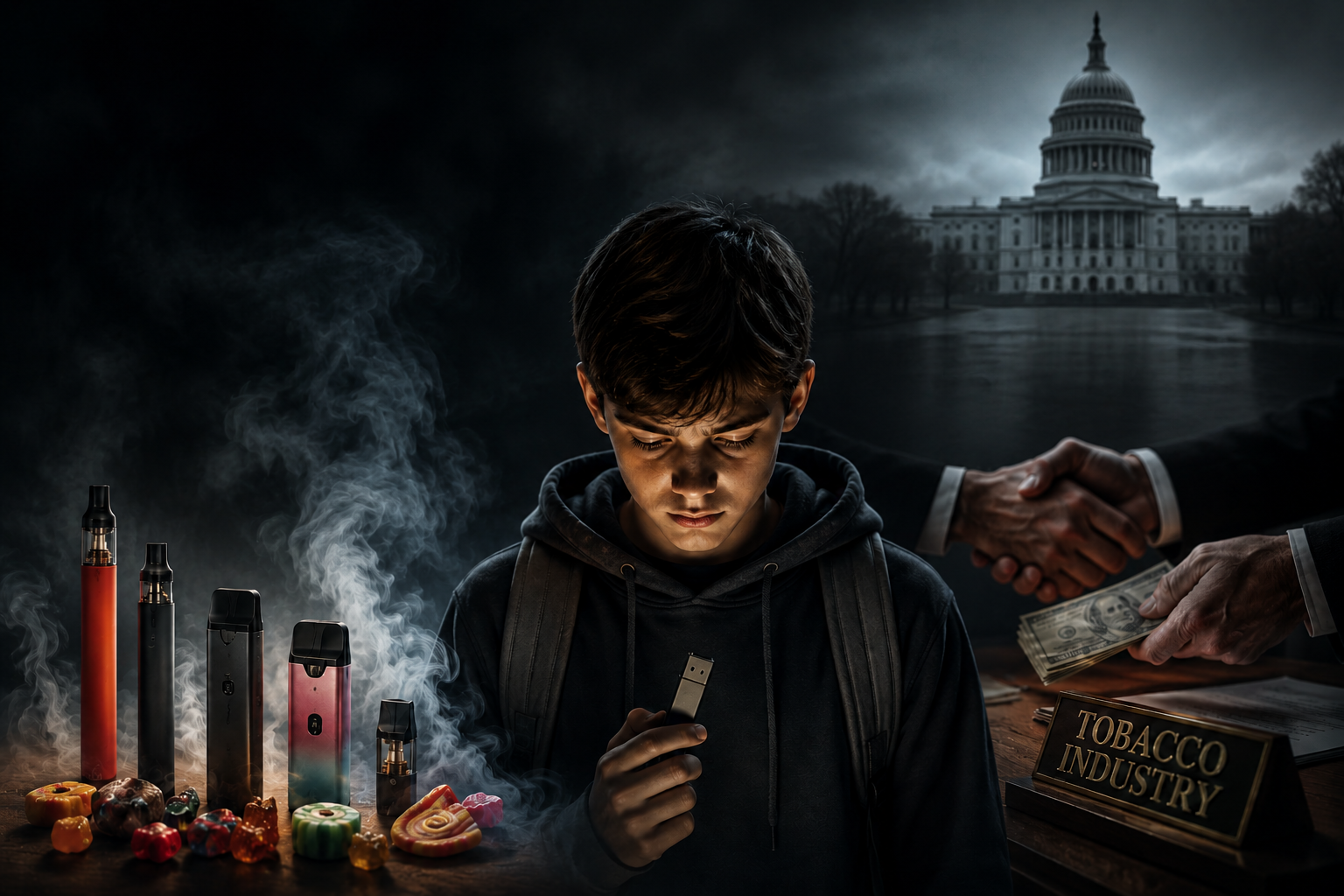
Today, another enemy fits into your child’s pocket. It looks something like a USB drive, but the reality holds a different picture.
They Planned This for Our Kids.
Let me be very direct with you. It is the only way I want you to know everything happening in the present times.
Big Tobacco didn’t just stumble into the vaping market. They engineered it deliberately and methodically, especially when cigarette sales are falling. Their main strategy was to create a generation of addicted customers. And by customers, I mean our children.
Here is what they decided to do:
They designed vaping devices resembling pens and USB drives so that parents won’t notice. They packed each small pod with as much nicotine as an entire packet of cigarettes. They ensured that technology makes the nicotine hit faster in your brain as compared to cigarettes. It includes adding candy and fruit flavors to make an appeal to teens as young as 13 years old, not adults. They even engineered devices to produce less visible vapors. As a result, the children can use them inside the classroom without ever getting caught.
This wasn’t an accident. This was a roadmap for our children to become prone to addiction.
How Big Tobacco Made Its Way to Your Child’s School
As a parent, you believe the story ended in the boardroom. You are totally wrong about it. It begins all the way to Washington.
This is what has happened. I want you to read this slowly because it matters.
Reynolds American is one of the biggest tobacco companies in the United States. The company donated 5 million dollars to a political super PAC supporting President Trump on 30th April 2026. That brings their total contributions to $8 million to the fund alone and $10 million more to a separate super PAC backing his campaign. Just two days after that, a 5 million donation, a top executive from Reynolds, and two other lobbyists had lunch with the president at his golf club in Florida. Executives from Altria and another major tobacco company were also at that table.
A week later, the Trump administration announced a new policy favoring e-cigarettes. This was the very policy that the tobacco industry was pushing for a really long time. It helps companies like Reynolds gain enormous market share as traditional tobacco continues to decline.
That’s not all. On the president’s second full day in office, his administration withdrew the proposed ban on menthol cigarettes. His team also devises a plan to slash sharply restricted nicotine levels in cigarettes. A measure that was only designed to reduce addiction earlier. The Reynolds executive donated around $2 million or more. They were personally invited to a White House dinner.
Money. Lunch. Policy. In that exact order.
I am not a politician. I am a mother and a community organizer from Butler, Pennsylvania. But I know what it looks like when people who are supposed to protect our children are sitting at the same table as the people trying to sell them nicotine.
The only sufferers are our children, who are caught in the middle of this.
My Experience of Conducting Our Workshops
I have over 20 years of experience in running Reality Tour events. There, I have addressed more than 55,000 parents and children. I know how the vaping conversation during the workshops transformed every room we walk into.
A few years ago, parents used to ask me, “Is vaping really that dangerous? Is it really just water vapor, isn’t it?
Today, the same parents are asking: “How do I know if my child’s vape has fentanyl in it?”
That’s how the time changes so fast.
At our workshops, we show parents what these devices look like. Their reactions are always the same. Shock, fear, and then determination. Mothers who thought they knew every item in their child’s backpack are left staring in disbelief. They realised that what they thought was a highlighter in their children’s bag was actually a vape pen.
Fathers who felt that their teen “would never” are now sitting down with a new kind of worry.
And the teens? Many of them didn’t know what they were really inhaling either. That’s the part that breaks my heart most.
The Numbers are Real so is the Progress
The work we do really does make a difference. According to the FDA and CDC’s 2024 National Youth Tobacco Survey, current e-cigarette use among middle and high school students has dropped from 21.3 million in 2023 to 1.63 million in 2024. The numbers show about half a million fewer kids using vaping in one year.
That progress happened because, as parents, teachers, community members, and non-profits like ours, we refused to stop spreading awareness.
But there is yet a danger that lies behind the good news. The youths who vape are 3 to 4 times more likely to go on smoking tobacco as compared to teens who do not vape. Exposure to nicotine can negatively affect the brain’s normal functioning and affect their concentration and impulse control.
Despite the changes, we cannot afford to celebrate and look away. A lot is yet to be done.
Step We Can Follow Today
After two decades of working in this field, here is what I know for certain. Parents are the single most powerful prevention tool that exists. Not any programmes, laws, or school policies are as powerful as you.
This is what will help you:
-
Know What the Devices Look Like
Go online. Search for “JUUL” and disposable vape pens right now. Look at the images carefully. Then check your child’s room, backpack, and jacket pockets with open eyes.
-
Start the Conversation Early and Keep It
You don’t need to lecture. You simply need to connect with your child. Try this: “I’ve been reading about what’s in those vape pens. Some of them have fentanyl now. I need you to know about it.” That’s it. Just plant the seed in your child’s mind.
-
Give Your Teen a Way Out
One of the most powerful tools that we share at Reality Tours is when a child says things like, “My parents randomly do drug tests. I never knew when.” This statement itself becomes armour rather than distrust.
-
Consider a Family Health Policy
We encourage families to normalise home drug testing from around age 11 to 12. Your child will end up growing up accepting this as normal. Celebrate when the drug test results are negative.
-
Keep an Eye on Social Media
Drug dealers on Snapchat use an electric plug emoji as a secret code to advertise drugs. If your child’s online life is a mystery to you, it is time to change that.
Final Thoughts
I started Reality Tours because one parent at a town meeting wanted to learn about drug risks along with her child. Now, the tobacco industry has billions of dollars, lobbyists, political donations, and now – a seat at the President’s lunch table on their side.
No matter what happens. We are the drovers of change. We are the community that decides to take care of its own. That has always been enough for us. It still is.